Bamboo Is Resourceful, And The Sustainable Potential of Bamboo Resources Is Limitless
Although innovative solutions are an important part of achieving sustainability in bamboo products, the recycling of items is the simplest way for everyone to achieve sustainability.
Last month, a research team led by Herbert Rabin, Honorary Professor of Electrical and Computer Engineering at the University of Maryland, and Liangbing Hu, Director of the Materials Innovation Center, published new research results in the field of bamboo fiber in the renowned academic journal Nature Sustainability. The research team successfully extracted high-performance crude fibers from bamboo using a delignification process (the process of removing lignin and hemicellulose from materials).
Sheldon Q. Shi, a professor of mechanical engineering at the University of North Texas, said, “The technology proposed in this study provides a revolutionary way to maximize the use of natural bamboo.” Yuan Yao, assistant professor of industrial ecology and sustainable systems at the Yale School of Environment, who participated in the research, also stated that “it has great potential for development as a new way of extracting materials, and through this rich and sustainable material, it can replace many carbon intensive materials to achieve an ecologically responsible future.
Donald W. Davies, President of American structural design firm Magnusson Klemic Associates, stated that “no building type or material can free us from the challenges of climate crisis and zero carbon emissions… When we build new things, we need to make each material take on its best part and create hybrid building solutions that optimize every aspect.” In his view, bamboo can be an important component of building solutions. In fact, bamboo has played an important role in different fields.
Bamboo has become an important ‘life companion’
Throughout history, humans have designed countless ways to enhance their lives by utilizing the uniqueness of bamboo. The analysis and forecast of the global bamboo products market (2021-2028) by Grand View Research, a US market research company, shows that the market size of bamboo products worldwide will be $53.28 billion in 2020, and will continue to grow at a compound annual growth rate of 5.7% from 2021 to 2028.

From personal items, textile materials to building materials, bamboo has entered various fields of life and households. The editorial team of Treehugger, a sustainable information reporting website, stated that bamboo can be used to replace various types of paper, wood, and even plastic. Daily utensils, utensils, and plastic household items such as toothbrushes and cooking utensils can all be made of bamboo. Mimi Ausland, co-founder of Free the Ocean, a non-profit organization that focuses on sustainability, said that bamboo products are often more beautiful and aesthetically pleasing than plastic products, and are the perfect combination of design and function. The Cheeky Panda, a British brand that uses bamboo to make daily necessities such as tissues, diapers, and straws, stated on its official website that “using bamboo instead of trees helps protect rainforests
The fashion industry has incorporated bamboo as a part of its raw material for producing fabrics. Linen fabric is made by spinning bamboo fibers into threads, while some softer bamboo bed sheets, clothing, and other items are derived from artificial silk made from bamboo. Fashion industry practitioners claim that bamboo is more sustainable than cotton, which requires a lot of water for its growth process, and unlike silk, bamboo is a zero cruelty, vegan material, “said Rebecca Smithers, a journalist for The Guardian
In the field of construction, due to the significant greenhouse gas emissions caused by materials such as steel and concrete, and the soil degradation caused by the extraction of raw resources such as rocks and gravel, people have turned to consider bamboo as a building material. Rebecca Smithers stated that bamboo is known as’ green steel ‘due to its versatility and extremely high strength, and Filipino architect Earl Forlales also stated that’ Filipinos have been using bamboo as a building material for thousands of years’.
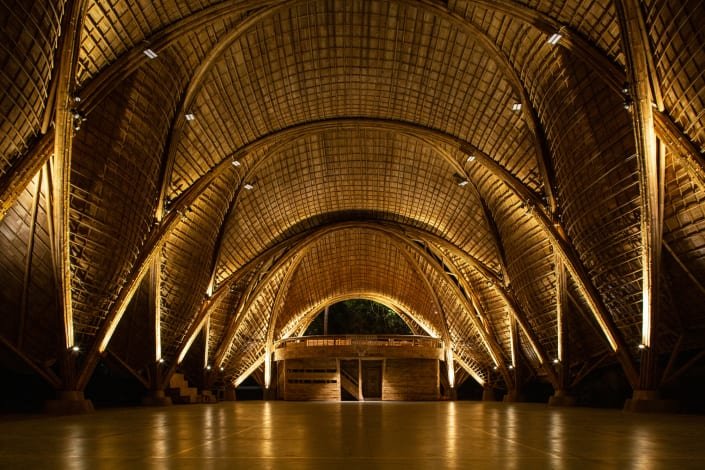
Canadian architect Elora Hardy’s bamboo architecture built in Bali(Image source: edition.cnn.com © Tommaso Riva/IBUKU)
In Asian regions where bamboo grows abundantly, bamboo is also a common source of food. Not only do pandas make a living by eating bamboo, but bamboo shoots are also commonly found in Asian cuisine due to their low fat and low calorie content, as well as being a source of fiber and potassium.
Bamboo is not only related to daily food and goods, but also a raw material for artistic creation. Israeli fashion designer and artist Anat Heifetz was inspired by the bamboo piled up on the roadside during his trip to the Philippines. He collaborated with local artists to paint and carve bamboo, and was subsequently invited to hold a solo exhibition of bamboo art at the Ayala Museum of Modern Art in Manila. Anat Heifetz later discovered that his painted bamboo was more like fabric design patterns, so he decided to try printing them on fabrics and based on this, designed and produced a series of clothing accessories.
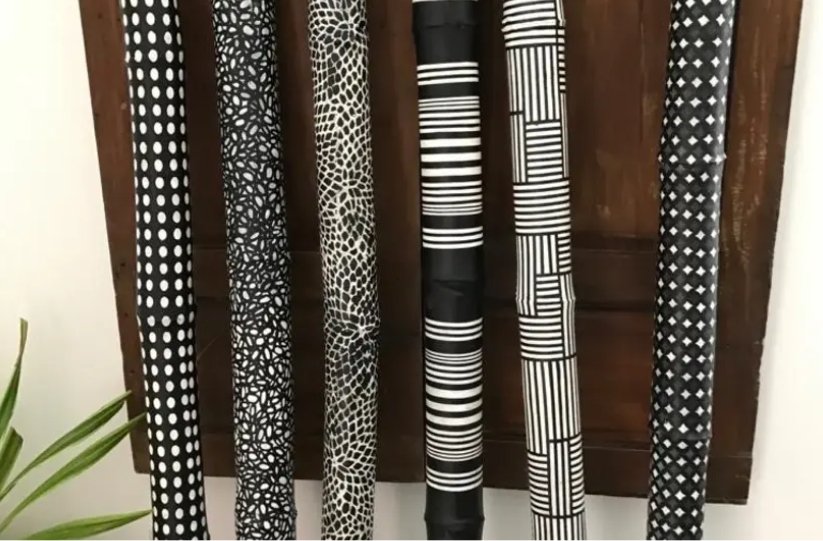
Bamboo Painting by Anat Heifetz (Image source: jpost.com)
There are both sustainable advantages and limitations
Bamboo is widely used in different fields and is considered a sustainable material depending on its inherent properties. As a plant, bamboo grows rapidly and can naturally regenerate. Compared to trees that take 30 years or even longer to grow, bamboo can grow within three to four months and reach maturity within one to five years. This means that bamboo can be harvested quickly and used as raw material. According to the Encyclopedia Britannica, there are over 1400 different types of bamboo currently in existence. Although most of these bamboo species are concentrated in China and Southeast Asia, the growth environment of bamboo is not limited. In addition to Asia, bamboo can also grow in Africa, Australia, Latin America, and the southern United States, and can survive in colder climates.
At the same time, although bamboo has shallow roots, it still forms a fiber network underground and interacts with the soil to improve soil conditions. After harvesting, bamboo can continue to grow along its original roots without the need for further planting, and the harvesting process will not affect the soil or roots. For planting areas, the soil improvement effect of bamboo can minimize landslides and weaken the impact of natural disasters during rainy and monsoon climates.
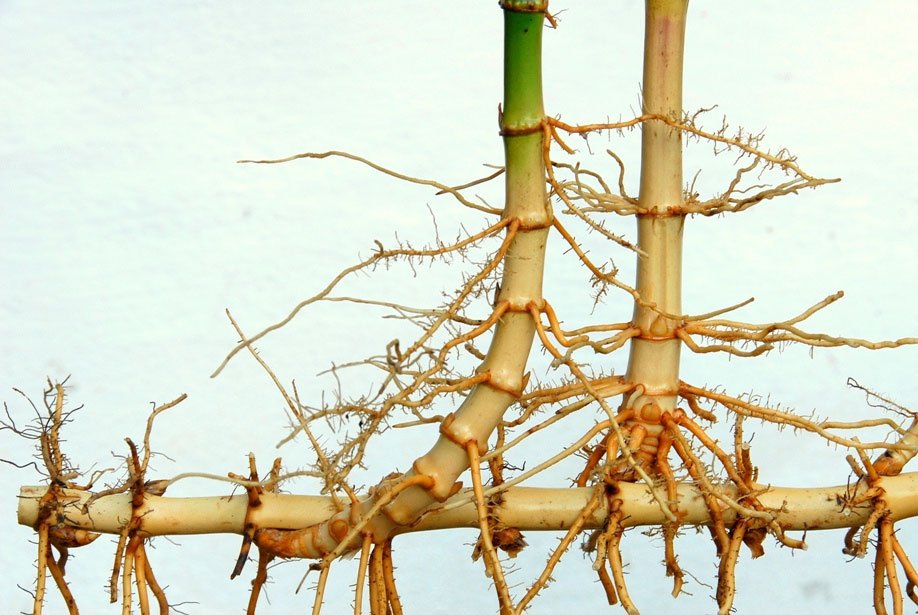
Root structure of bamboo(Image source: bamboobotanicals. ca)
In addition, bamboo can grow healthily without the need for chemical products such as insecticides and herbicides, and its planting process only requires a small amount of water resources, allowing it to grow tenaciously even in areas with limited water resources. In addition to its rapid growth characteristics, the editorial team of sustainable information reporting website Treehugger pointed out that “bamboo absorbs twice as much carbon dioxide as trees and produces 30% more oxygen than most plants and trees.” From the perspective of carbon emissions, the widespread planting of bamboo can absorb a large amount of carbon dioxide and have a positive impact on the climate and environment. Another criterion for determining whether a material is sustainable is whether it can be used for a long time. Rebecca Cairns, editor of CNN, said, “After processing and design, bamboo structured housing can stand for decades.
Bamboo is a very suitable sustainable material due to its adaptability, friendliness to local soil, and long-term usability, but it is not perfect either. Firstly, the planting process of bamboo has negative effects. Paula Chin, a materials expert at the World Wildlife Fund’s UK branch, stated that “areas where bamboo is grown do not promote biodiversity like forests, especially in areas specifically designed for bamboo cultivation. According to Bethany Carter, author of the UK sustainable lifestyle website Eco&Beyond, bamboo is often grown as a monoculture, meaning that in some areas, other plant species are removed in order to cultivate bamboo. This monoculture poses serious survival problems for fungi, bacteria, insects, and other small animals that rely on diverse ecosystems for nutrition and habitat.
Secondly, Phil Purnell, a visiting professor at the Materials Science Research Centre of the Royal College of Art in the UK, warns that ‘some of the ingredients used to make bamboo fiber fabrics do not come from bamboo itself’. As for bamboo based artificial silk, Christina Cogdell, the head of the design department at the University of California, Davis, explained that it is usually made by adhesive technology. The process itself involves dissolving bamboo in a chemical solution to produce a paste like viscous substance and spinning it into fibers, which are then made into threads and fabrics. The entire process involves a large amount of chemicals, and about 50% of the components cannot be recycled or reused. Based on this, the Global Organic Textile Standard, jointly developed and published by an international working group consisting of the International Association of Natural Textiles, the Japan Organic Cotton Association, the American Organic Trade Association, and the British Soil Association, and internationally recognized, refuses to certify chemically processed bamboo viscose fibers, stating that they “cannot be considered natural fibers or even organic fibers”.
Bethany Carter also pointed out that although bamboo can survive in multiple places and conditions, “a large amount of bamboo currently comes from China,” which means that most bamboo products in most countries need to be transported across borders. “No matter how beneficial bamboo itself is to the environment, the transportation distance of products will greatly affect their carbon footprint.
Improve sustainable future with innovative solutions
Bethany Carter believes that evaluating the sustainability of bamboo is not an easy question to answer, as bamboo has a natural growth advantage compared to trees with higher maintenance costs and longer growth times; Compared to plastic, which threatens numerous marine organisms and damages the environment, bamboo has not yet caused such a heavy burden on the environment. Most bamboo can be composted, but plastic can never be composted. However, both involve harmful chemicals to varying degrees in the production process, and there is actually no winner in the balance of the two harms.
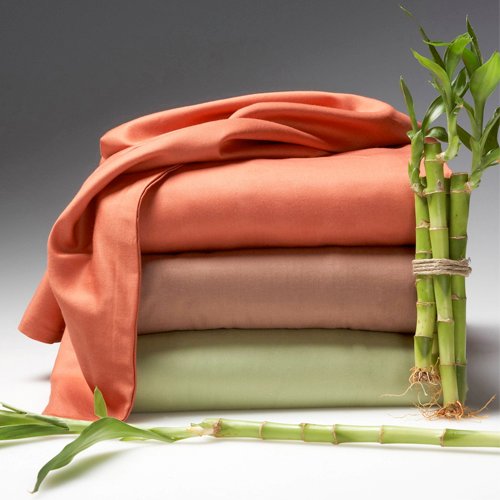
The singularity of bamboo planting process will affect biodiversity, which is difficult to eliminate. However, in terms of processing methods, many researchers have developed more sustainable solutions to reduce environmental damage. As for bamboo based artificial silk, researchers in the field of jute and fiber technology at the University of Kolkata in India have explained that the Lyocell spinning process has become a mature and environmentally friendly textile technology. Lyocell fibers are made from pulp formed by crushing bamboo, and the solvent used to dissolve bamboo can be continuously recycled and reused after the dissolution process without becoming part of the fabric. The recovery rate can reach 99.5%, so artificial silk produced through this process can be called environmentally friendly materials.

Bedding made by Lyocell spinning process(Image source: earthhero.com)
As a new type of building material, bamboo is widely used as a substitute for reinforced concrete due to its flexibility, earthquake resistance, strength, and lightweight. However, in the current use process, bamboo still needs to rely on other materials such as steel or wooden connectors to achieve stability, which are not sustainable. In order to achieve less carbon emissions from buildings, the digital building technology research team at the Swiss Federal Institute of Technology in Zurich (Eidgen ö ssische Technische Hochschule Z ü rich) used 3D printing technology to print the parts needed to connect bamboo to replace the original materials, while also avoiding the carbon emissions generated by part transportation. The team has combined craftsmanship with modern technology to create a more sustainable and efficient building system, and this architectural research was exhibited at the Venice Architecture Biennale in 2021.
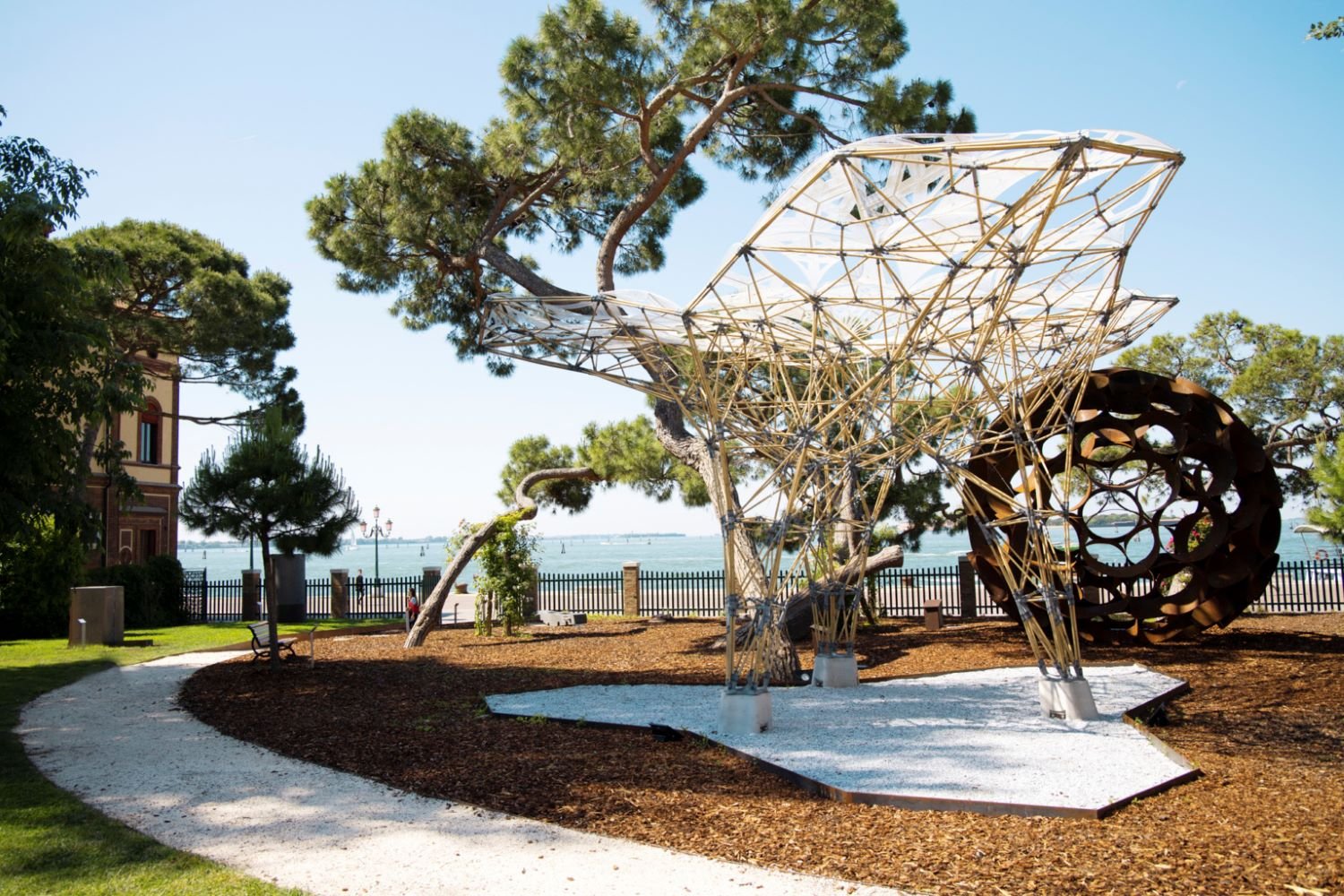
Image source: “Digital Bamboo” architectural structure combining bamboo and 3D printing(Image source: timespaceexistence.com © Federico Vespignani)
In order to better ensure that bamboo becomes a sustainable alternative to plastic, Indian startup Bio Craft Innovation has been committed to promoting research on biotechnology innovation since 2019 and has developed special bamboo based IBANS particles. According to Anubhav Mittal, founder and CEO of the company, “IBANS pellets are made from cellulose derived from agricultural waste and non wood sources such as bamboo We collect agricultural waste and convert it into cellulose fibers after obtaining it. Then, starch and additives are used to convert these fibers into thermoplastic particles that can be processed on plastic making machines, making them into tableware such as bowls, plates, and other containers that are completely biodegradable at the end of their lifecycle and can be used for composting without any expensive recycling processes.
Based on the abundant bamboo resources in the local area, with a planting area of over 15 million hectares, Bio Craft Innovation is also trying to use bamboo based IBANS particles to manufacture masks made entirely of biopolymers that provide 95% and 99% protection to meet the demand for medical protective equipment after the epidemic. Anubhav Mittal previously announced that protective masks will be launched soon.
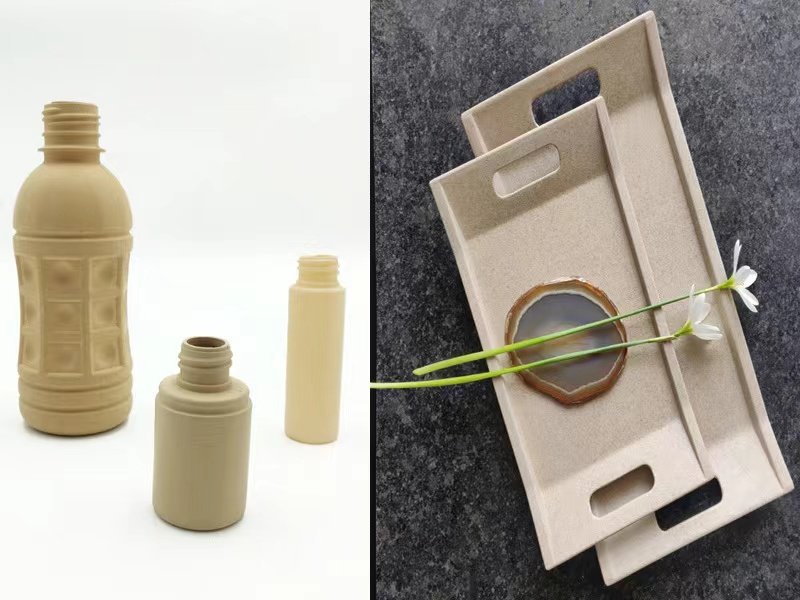
Containers and trays made of bamboo based IBANS granules(Image source: indiablaoms.com)
Although innovative solutions are an important part of achieving sustainability in bamboo products, the recycling of items is the simplest way for everyone to achieve sustainability. Dr. Rhoda Trimingham, a sustainable design research group at Loughborough University in the UK, stated that “many retailers have replaced their previously used disposable plastic tableware with bamboo, but due to consumers’ perception that the product is disposable, it is still likely to be thrown away.” Therefore, for consumers, “the most important rule of environmental protection is to reduce use, recycle, and effectively recycle.
(This article is sourced from www.cls.cn)